
Water That Smells Like Rotten Eggs
Bore, tank and hot water smells.
Book a FREE onsite visit.
What causes a rotten egg smell?
A rotten egg smell in your water is usually hydrogen sulphide gas. It’s made by bacteria that live where there’s no oxygen, turning the sulphate in water into hydrogen sulphide. That can happen:
- In the ground, in low-oxygen bore water.
- In the bore, pipes or a storage tank, where sulphur bacteria grow.
- In your hot water cylinder, which is why sometimes only the hot taps smell.
- In a water softener or filter that has bacteria growing in it.
We’re not in a volcanic area like Rotorua, so around here it’s usually bacteria, most often on bore water. You can smell it at tiny amounts: Taumata Arowai’s aesthetic value is just 0.05 mg/L, set as the taste and odour threshold.
Smell gas? LPG and natural gas have a rotten egg smell added on purpose. If the smell is in the air rather than the water, WorkSafe says don’t use switches or phones, turn off the gas at the meter or cylinder, open the windows, and go outside and call for help if it doesn’t clear.
We track down and fix smelly water on bores, tanks and hot water systems across Rodney and North Auckland, from Mangawhai to Albany.
Start with a free onsite visit.
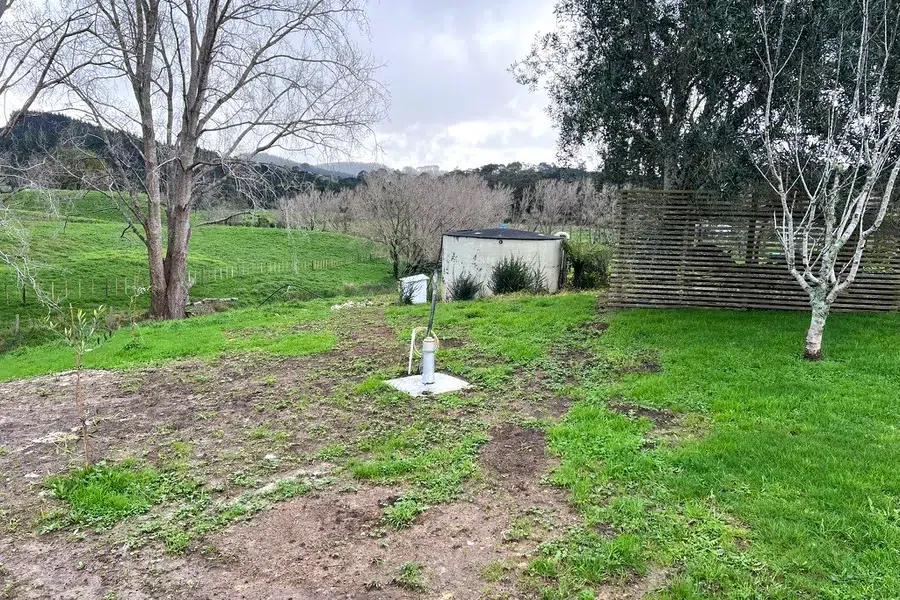
What hydrogen sulphide does
At the levels found in drinking water, hydrogen sulphide isn’t considered a health risk. The World Health Organization sets no health limit for it, and neither does New Zealand. But it’s more than a nasty smell.
It corrodes your plumbing
Hydrogen sulphide attacks iron, steel, copper and brass. It blackens silverware and copper fittings, and with iron it can turn water black.
It spoils the taste
Coffee, tea and cooking water taste off, and the smell is often strongest in a hot shower, where the heat drives the gas out.
It gets in the way of other treatment
Hydrogen sulphide can foul softener resin and some iron filter media. A UV system doesn’t remove it, and neither does a sediment filter, because it’s a dissolved gas.
It’s worth testing
The smell usually has nothing to do with sewage, but bacteria are involved, and very occasionally pollution is the cause. The Minnesota Department of Health suggests testing for E. coli and nitrate to be safe.
Signs of hydrogen sulphide
A rotten egg smell from the taps.
A stronger smell in the shower or from the hot taps.
A smell that’s worst when you first turn on the tap.
Black stains in sinks, basins and toilets.
Silverware and copper turning black.
Black water or black slime.
Coffee and tea that taste off.
A softener or filter that smells.
Hot water that smells after the cylinder has sat unused.
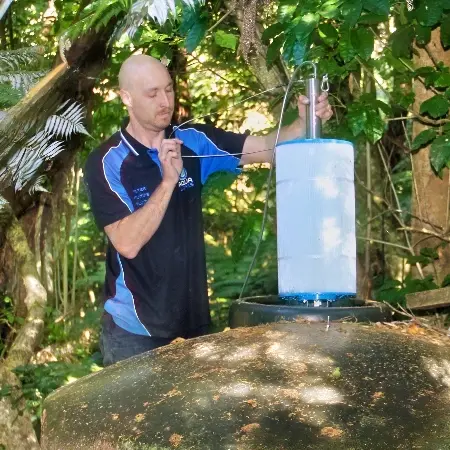
Ozone in the tank is our usual fix for a smelly bore. See ozone tank treatment.

Sized to your water. We test first, then match the treatment to how strong the smell is and what else is in the water.
What treatment does
- Gets rid of the rotten egg smell.
- Protects copper, brass and silverware.
- Stops new black stains.
- Lets your softener, filters and UV do their jobs.
What won’t fix it
- A sediment filter. The smell is a dissolved gas.
- A UV system. It kills bugs but doesn’t remove the gas.
- An ordinary water softener, which can get fouled.
- Treating the water when the smell is from a drain.
Find the source, then fix it.
Where is the smell coming from?
Which taps smell tells you where to look.
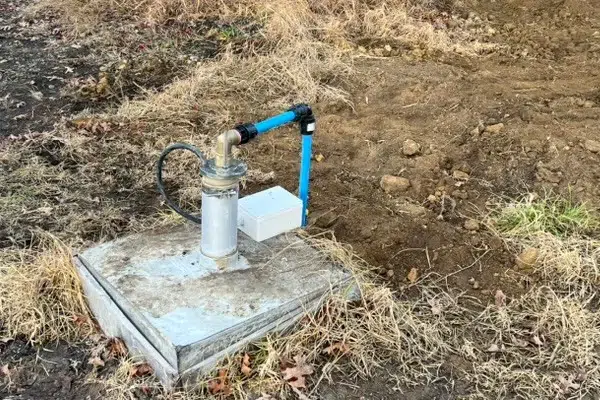
Hot and cold taps: the bore water itself, or sulphur bacteria in the bore and pipes. If the smell fades after a few minutes of running, it’s more likely bacteria.
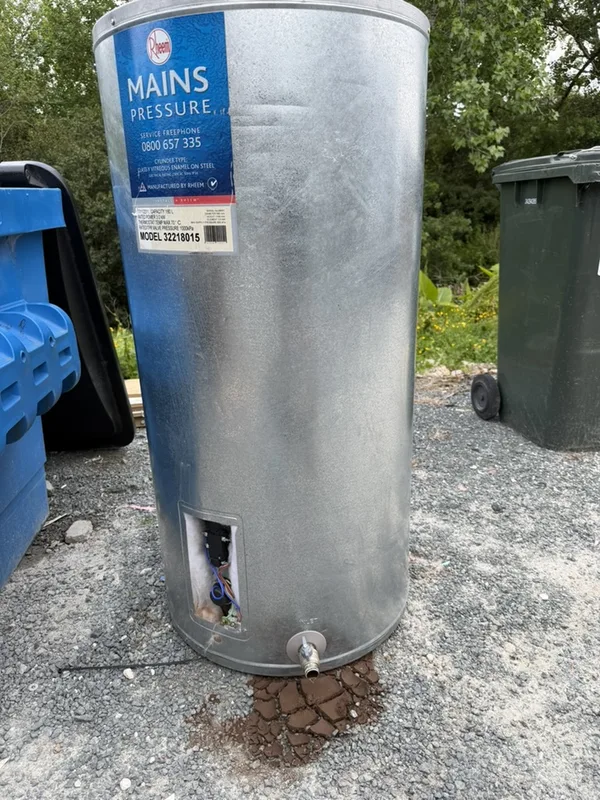
Hot taps only: the hot water cylinder, where the anode rod or bacteria make the gas. See hot water cylinders.
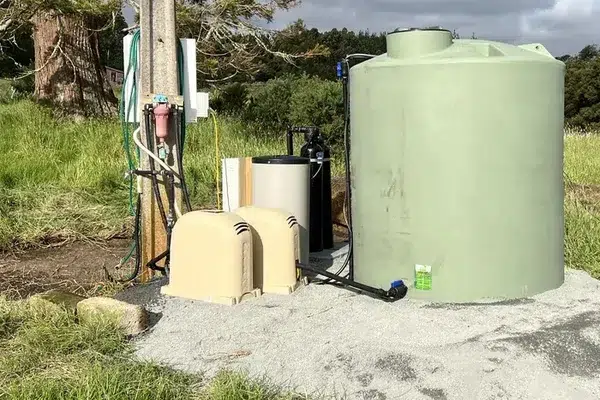
Softened taps only: bacteria growing in the softener. Taps that bypass it won’t smell. See water softeners.
How we fix a smelly bore
We usually pump the bore water into a tank near the bore and treat it with ozone, which gets rid of the smell. Ozone turns the hydrogen sulphide into fine sulphur and then sulphate. It doesn’t stay in the water, so sediment filters and UV still go after it at the house.
For a really strong smell, we add aeration as well: the water sprays up inside the tank, which helps drive the gas out, and the ozone does the rest. Light smells can sometimes be handled with carbon. We test first and match the treatment to the level.
Find the source first
The fix depends on where the smell comes from, so start with a simple check. The Minnesota Department of Health suggests this one. After the water hasn’t been used for a few hours, smell the hot and cold taps.
- Only the hot taps smell: it’s the hot water cylinder.
- The cold smells too, but fades after a few minutes of running: sulphur bacteria in the bore or pipes.
- The cold smells and doesn’t fade: hydrogen sulphide in the bore water itself.
- Only the softened taps smell: bacteria in the softener.
Is it the drain? Fill a glass of cold water and smell it in another room. If it doesn’t smell there, the smell is coming from the drain, not the water. A trap that has dried out, often in a spare bathroom, lets sewer gas in. Running some water through it usually fixes that.
Smelly tank water that doesn’t smell like rotten eggs, such as musty, earthy or fishy, usually has a different cause: see smelly drinking water.
Hot taps only? Check the cylinder
If only the hot taps smell, the cylinder is the usual cause. Most cylinders have a magnesium anode rod that protects the tank from corrosion. With some water it reacts with sulphate to make hydrogen sulphide, and the warm water also suits sulphur bacteria.
Flushing and disinfecting the cylinder can help, though bacteria can come back. See hot water cylinders.
Test your water
Hydrogen sulphide escapes from water quickly, so it has to be measured on site or in a specially preserved sample. Hill Laboratories uses a bottle with a preservative, kept chilled and tested within 48 hours.
We also test for sulphate, iron, manganese, pH and dissolved solids, and for E. coli and nitrate to rule out pollution. See water testing.
How we fix smelly water
Every job follows the same four steps.
1
Free onsite visit
We check which taps smell and look at your bore, tanks, softener and cylinder.
2
Test the water
We take a preserved sample for hydrogen sulphide, plus sulphate, iron and more.
3
Install
Our registered plumbers fit the treatment, filters and UV to suit your water.
4
Service
We service the system every year, check the smell is gone, and remind you when it’s due.
Smelly water and the rest of your system
Tap a card to find out more.
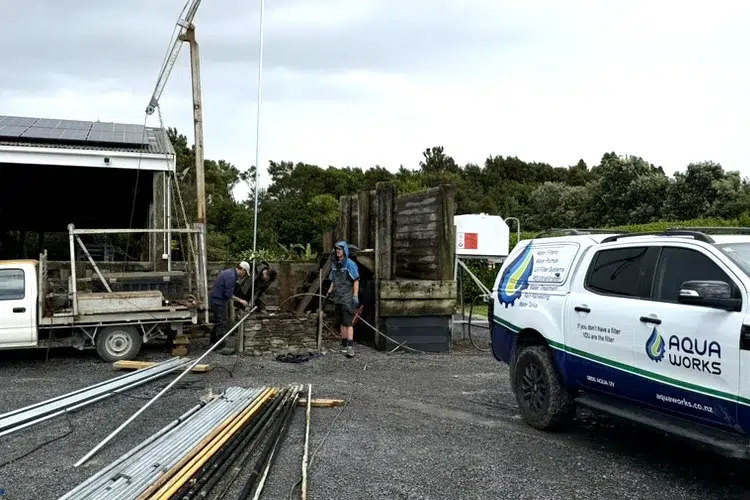
Bore water
We test bore water and design the treatment to suit.

Ozone tank treatment
Our usual fix for a smelly bore, treating the water in the tank.
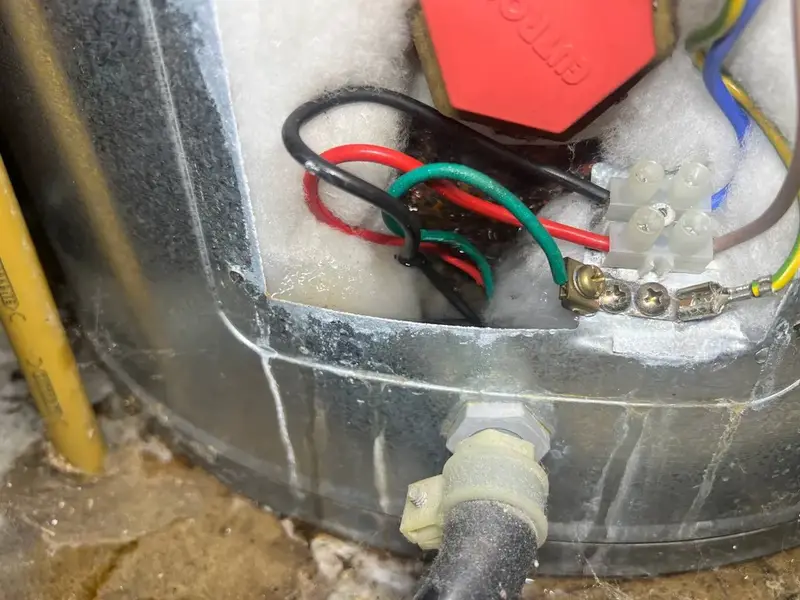
Hot water cylinders
Repairs, replacements and new cylinders, from Mangawhai to Albany.
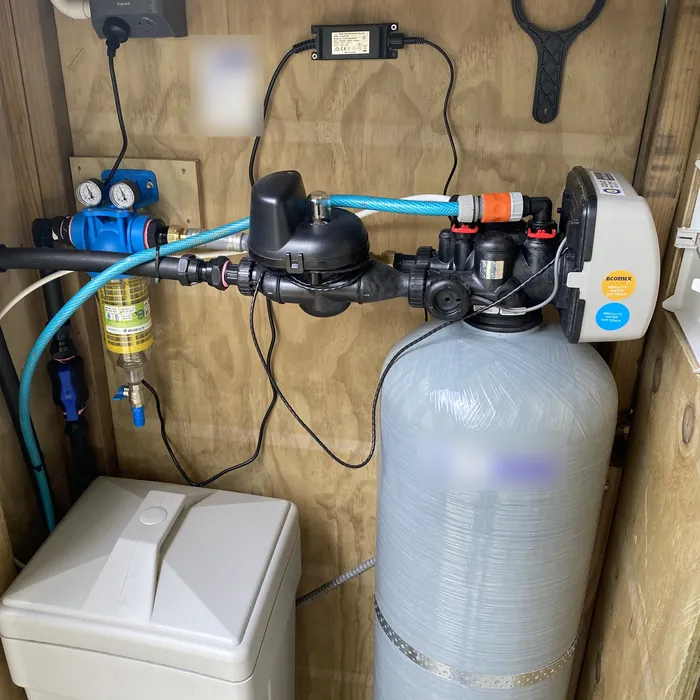
Water softeners
For hard water, iron and manganese. Serviced so bacteria don’t build up.

Smelly tank water
Musty, earthy or fishy tank water: five things to check.

Water testing
Lab tests for your water, with the results explained.
Professional installation
Our own registered plumbers fix smelly water across Rodney and North Auckland, from Mangawhai to Albany.
- We find the source before we fit anything.
- Treatment matched to a lab test of your water.
- Filters and UV after the treatment, so every tap is safe.
- Hot water cylinders checked and repaired by our plumbers.
Ongoing service and support
We service your ozone system, filters and UV at the same visit, and remind you when it’s due. We service most makes and models: see water filter and softener servicing.
Rotten egg smell FAQs
Why does my water smell like rotten eggs?
Usually hydrogen sulphide gas. Bacteria that live where there’s no oxygen turn the sulphate in water into hydrogen sulphide, in the ground, in the bore or pipes, in a softener or in the hot water cylinder.
Is it safe to drink water that smells like rotten eggs?
At the levels found in drinking water, hydrogen sulphide isn’t considered a health risk, and there’s no health limit for it. But bacteria are involved, and very occasionally pollution is the cause, so test for E. coli and nitrate. Bore water needs filters and UV before you drink it anyway.
Why do only my hot taps smell like rotten eggs?
The hot water cylinder is the usual cause. Its magnesium anode rod can react with sulphate in the water to make hydrogen sulphide, and the warm water suits sulphur bacteria.
Why does my bore water smell?
Either hydrogen sulphide in the groundwater itself, or sulphur bacteria in the bore and pipes. If the smell fades after a few minutes of running, bacteria are more likely. A lab test with a preserved sample tells us how strong it is.
Does ozone get rid of the smell?
Yes. We usually pump the bore water into a tank near the bore and treat it with ozone, which gets rid of the smell. Ozone turns hydrogen sulphide into sulphur and then sulphate. Filters and UV still go after it. See ozone tank treatment.
Will a carbon filter remove the smell?
Only a light smell, roughly under 1 mg/L, and the carbon gets used up quickly. Stronger smells need ozone, and for a really strong smell we add aeration in the tank as well.
Will a water softener or UV system fix it?
No. A UV system kills bugs but doesn’t remove the gas, and an ordinary softener doesn’t remove it either and can get fouled by it. Sometimes bacteria in a softener are the cause of the smell.
Could the smell be my drains?
Fill a glass of cold water and smell it in another room. If it doesn’t smell there, it’s the drain. A trap that has dried out, often in a spare bathroom, lets sewer gas in. Run some water through it.
What if it smells like gas?
LPG and natural gas have a rotten egg smell added on purpose. WorkSafe says don’t use switches or phones, turn the gas off at the meter or cylinder, open the windows, and go outside and call for help if the smell doesn’t clear.
How do you test for hydrogen sulphide?
It escapes from water quickly, so it has to be measured on site or in a preserved sample. Hill Laboratories uses a bottle with a preservative, kept chilled and tested within 48 hours. We also test for sulphate, iron, manganese, pH, dissolved solids, E. coli and nitrate.
Don’t just take our word for it…

⭐⭐⭐⭐⭐
“We have an advanced rain water treatment system at our Mangawhai Heads home which includes whole house neutralisation, UV treatment and 3-stage filtration with KDF/GAC, primarily for removal of copper contamination from gutters and down pipes. The system was supplied and installed by Aqua Works and has just had its first annual service by them. We have been totally satisfied with the expert service throughout …”
Richard Mules, 2025
⭐⭐⭐⭐⭐
“Thank you to Aqua Filter Rodney, we had excellent service, fast, efficient, the serviceman was really great to deal with, and our tea and coffee now tastes like it should, wouldn’t be without the system, it’s marvelous.”
Merryl Houghton, 2021
⭐⭐⭐⭐⭐
“These guys know their stuff. Steve & the team are absolute professionals, what they don’t know about water isn’t worth knowing! Highly recommend Aqua Works!”
Marcus L, 2022
Water smells like rotten eggs?
Book a FREE onsite visit. We’ll find where the smell is coming from and fix it.