Nitrate in Water
Testing and Reverse Osmosis Solutions for Safe Drinking Water
Call 0800 278 296 to talk to a water expert
Worried about nitrate in your water? Do this now
1
Don’t use it for baby formula
If you have a baby under six months, use bottled water or another safe supply until your water is tested.
2
Don’t boil it to make it safe
Boiling doesn’t remove nitrate. It concentrates it as the water evaporates.
3
Pregnant?
Talk to your midwife or GP, and consider another drinking water source until you know your nitrate level.
4
Get your water tested
Call Aqua Works and we’ll arrange an accredited lab test and talk you through the result.
Do you have nitrates in your drinking water?
Nitrate (often called nitrates) has no taste, colour or smell. It’s a form of nitrogen that washes off farmland into rivers and soaks down into groundwater, so it’s most common in bore water and in rivers that run through farmland, like the Waikato. Nitrate is one of several contaminants in drinking water we help homeowners deal with.
Nitrate has been in the news a lot over the last two years, from rising levels in Canterbury’s groundwater to a 2026 New Zealand study linking nitrate in drinking water to premature births.
Does Auckland’s water come from the Waikato River?
Partly, yes. Watercare says that if you live in metropolitan Auckland, some of your water comes from the Waikato River. How much depends on the season, and it can take up to 225 million litres a day when the dams run low in a dry summer. Auckland’s metropolitan network runs from Pukekohe in the south to Waiwera in the north.
Waikato Regional Council monitoring shows nitrogen in the Waikato River has been slowly rising for decades, mostly from farmland. Treated town water meets the drinking water standards, but normal water treatment isn’t designed to remove nitrate.
Getting your water tested is the first step. If nitrate is a concern, an under-bench reverse osmosis system is the most reliable way to remove it from your drinking water.

Understanding the risk of nitrate in drinking water
How does nitrate get into water?
Most nitrate comes from land use, and it can take years to reach groundwater. Common sources include:
- Fertiliser on farms and market gardens
- Animal effluent from dairy and other intensive farming
- Septic tanks and wastewater systems
- Runoff into rivers and streams that feed town supplies
Is nitrate a risk in New Zealand?
Most town supplies have low nitrate, but levels are rising in some areas. In Canterbury, some private bores have tested above the legal limit, and because nitrate can take years to move through groundwater, levels in some areas may keep rising for a while yet.
Closer to home, aquifers under market gardens and dairy farms around Pukekohe and the Hauraki Plains have tested above drinking water guidelines, and nitrogen in the Waikato River is slowly rising.
Could your water be affected?
- Do you use bore or spring water?
- Is your bore shallow, or near farmland, market gardens or a septic tank?
- Are you on Auckland town supply and want to know what’s in it?
- Are you pregnant, or making formula for a baby?
- Has your water never been tested for nitrate?
Concerned about nitrates in your water? Start with testing.
Nitrate can only be measured with a lab test. We arrange testing through Hill Laboratories in Hamilton, an accredited lab. If you’re on town supply, Watercare or your council also publishes water quality results.
What doesn’t work
Nitrate is dissolved in the water, so most everyday treatments don’t touch it.
Common approaches that don’t work include:
- Boiling: it concentrates nitrate rather than removing it
- UV filters: they kill germs but don’t remove nitrate
- Carbon and sediment filters: they improve taste and catch particles, but nitrate passes straight through
- Assuming clear water is safe: nitrate has no taste, colour or smell
Why reverse osmosis works
A reverse osmosis membrane has pores fine enough to hold back dissolved salts like nitrate. That’s why reverse osmosis is the treatment we use for nitrate in drinking water.
Testing first means you know your nitrate level and can check the system is doing its job.
Health risks associated with nitrate
Blue baby syndrome in bottle-fed babies under six months, which reduces the blood’s ability to carry oxygen
A higher risk of premature birth, according to a 2026 New Zealand study
A possible higher risk of bowel cancer with long-term exposure
Higher levels and longer exposure mean higher risk
The current limit was set to protect babies from blue baby syndrome. Newer research suggests lower levels may still matter, and health officials are reviewing the evidence.
How Aqua Works removes nitrates from your drinking water
Nitrate is dissolved in the water, so it needs the right filter, not just any filter.
1
Test your water
We arrange an accredited lab test through Hill Laboratories, so you know your nitrate level and what else is in your water.
2
Check the source
For bores and springs, we look at bore depth, nearby farming and market gardens, and septic tanks to understand where the nitrate is coming from.
3
Install reverse osmosis
An under-bench reverse osmosis system is the most reliable way to remove nitrate from your drinking and cooking water.
4
Service and retest
Reverse osmosis filters and membranes need changing on time.
We keep a record of your system, remind you when it’s due for a service and retest your water when needed.
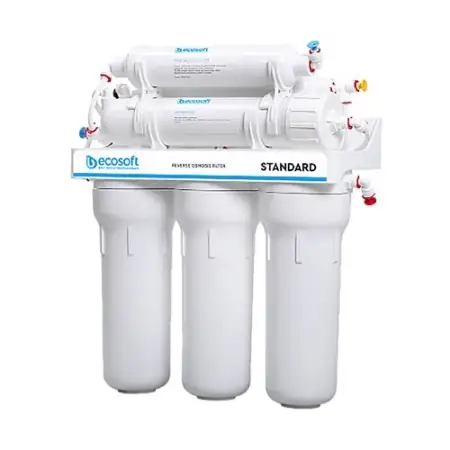
Featured Product
Ecosoft Under Bench Reverse Osmosis System
6 stages of advanced water purification!
Why? Call us on 0800 278 296 and talk to our water filtration experts!
Nitrate in water FAQs
What is the safe level of nitrate in drinking water in NZ?
The maximum acceptable value is 50 mg/L as nitrate, which is the same as 11.3 mg/L as nitrate-nitrogen (the way most lab results report it). It was set to protect bottle-fed babies from blue baby syndrome. Newer research suggests lower levels may also matter, and health officials are reviewing the evidence.
Can you taste or smell nitrate in water?
No. Water with high nitrate looks, smells and tastes normal. A lab test is the only way to know.
Does Auckland’s tap water contain nitrate from the Waikato River?
Some of metropolitan Auckland’s water comes from the Waikato River, more so in dry summers. Watercare’s treated water meets the drinking water standards, and most public supplies in New Zealand have low nitrate. But nitrogen in the Waikato River has been slowly rising, and normal treatment isn’t designed to remove nitrate. If you want it out of your drinking water, reverse osmosis is the most reliable option.
Is bore water more at risk from nitrate?
Yes. Shallow bores and springs near dairy farms, market gardens or septic tanks are most at risk, because nitrate soaks down into groundwater. Private supplies aren’t monitored the way town supplies are, so testing is up to you.
Is rainwater tank water at risk from nitrate?
Rainwater is usually low in nitrate. The bigger risk for tank water is bacteria like E. coli. If your tank is topped up from a bore, test that water too.
Does boiling water remove nitrate?
No. Boiling kills germs, but it doesn’t remove nitrate. As water boils away, the nitrate that’s left becomes more concentrated.
Will a UV or carbon filter remove nitrate?
No. A UV water filter kills bacteria, viruses and parasites, and a carbon filter improves taste and removes some chemicals, but neither removes nitrate. Reverse osmosis does.
How do I remove nitrates from my drinking water?
For drinking and cooking water, an under-bench reverse osmosis system is the most reliable option, and it’s what we install for nitrate. Have your water tested first so the system suits your water.
Is nitrate in drinking water linked to premature birth?
A 2026 study of more than 735,000 New Zealand births found that higher nitrate levels in drinking water were linked to a slightly higher risk of premature birth, even at levels well below the current limit. The researchers estimate around 120 premature births a year could be linked to nitrate. The study shows a link but can’t prove cause and effect.