E. coli in Water
Testing and UV Filtration Solutions
Get safe drinking water. Talk to a Water Specialist
Do you have E. coli in your drinking water?
If you rely on rainwater tanks, bore water, or other untreated water sources, protecting your drinking water from E. coli is essential. E. coli is a bacteria that can enter water supplies through animal waste, birds on roofs, contaminated gutters, or surface water flowing into tanks and bores.
E. coli cannot be seen, tasted or smelled, so testing is the only reliable way to confirm if your water is safe.
What is E. coli in drinking water?
E. coli is a bacteria found in the intestines of humans and animals, and one of the most common contaminants in drinking water in New Zealand. Its presence indicates faecal contamination and suggests that other harmful microorganisms, such as Giardia and Campylobacter, may also be present, making the water unsafe to drink.
At Aqua Works we help identify water contamination through professional testing and install reliable treatment systems that protect your household water supply.
If you are unsure about your water’s safety, the first step is to have it tested. Call us for peace of mind.
Order a water test today.

Found E. coli in your water? Do this now
1
Stop drinking the water
Don’t use it for drinking, cooking, making ice or brushing teeth.
2
Boil it or use bottled water
Bring water to a rolling boil for one minute, or let an electric kettle boil until it switches off. Boiling only treats the water you boil, so it’s a short-term fix.
4
Call Aqua Works
We’ll find out how E. coli is getting in, fix the source, install the right treatment and retest your water.
How E. coli gets into your water supply
E. coli enters drinking water through faecal contamination from animals or humans. Because the bacteria live in the intestines of warm-blooded animals, their presence in water indicates that waste has entered the supply.

Animal poo and roof runoff (tank water)
For rainwater tanks, contamination often occurs when birds, possums, rats or other animals leave droppings on roofs and in gutters. When it rains, this material is washed into your tank, introducing bacteria into your water supply.

Bore and groundwater contamination
Groundwater sources such as bores, springs, and wells can become contaminated if bacteria from surrounding soil or surface water enter the water supply. This is more common in rural areas or where protection around the bore is limited.

Surface water contamination
E. coli can also enter water systems through surface runoff, especially after heavy rain. Water flowing over land can carry animal waste, soil, and organic material into tanks, creeks, or groundwater sources.

Rural and agricultural environments
In rural areas of Rodney and Kaipara, contamination from manure, livestock, septic systems, or wildlife is common. Faecal material from animals or waste systems can enter water supplies and lead to bacterial contamination.
71
schools reported E. coli in 2025
Did you know?
E. coli is more common than most people think. In 2025, 71 schools on their own water reported E. coli contamination, and about 24 of them had it more than once. Schools made up 53% of all the E. coli contamination reported to the regulator.
Schools test their water every month, so they find it. Most homes on tank or bore water are never tested, so they wouldn’t know. Source: Water Services Authority (Taumata Arowai)
Why E. coli in water is a serious risk
E. coli in drinking water is a strong indicator of faecal contamination. This means that other harmful microorganisms, including bacteria, viruses, and parasites, may also be present.
If E. coli is detected, the water is considered unsafe to drink and should not be used without treatment. Even clear, clean-looking water can still contain harmful pathogens.
Found E. coli in a test? See what to do now.
When should you test your water?
- After heavy rain or flooding
- If birds, possums or rats can get onto your roof or into your tank
- After tank cleaning, plumbing work or a new connection
- If anyone in the house has an upset stomach
- If your water has never been tested
Health risks associated with E. coli infection
Stomach cramps and abdominal pain
Diarrhoea, which can sometimes be severe
Nausea and vomiting
Fever
Dehydration caused by fluid loss
Fatigue and weakness
Intestinal inflammation and irritation
In rare cases, kidney complications such as haemolytic uraemic syndrome (HUS)
In severe cases, the infection can enter the bloodstream causing septicaemia (blood poisoning), which may lead to organ failure and, in rare circumstances, death
The Drinking Water Standards for New Zealand 2022, regulated by Taumata Arowai, set the legal limit for E. coli in potable water.
Zero tolerance: E. coli must be undetectable (less than 1 cfu or MPN per 100 mL).
Featured Product
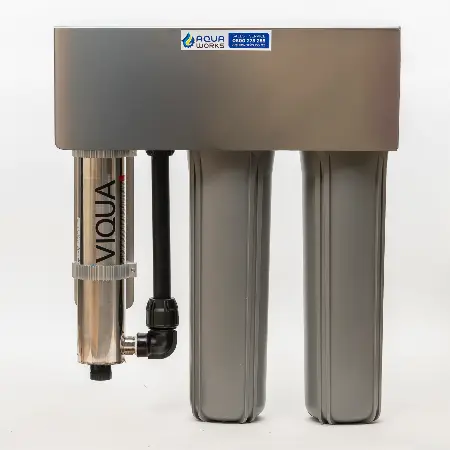
Aqua Jumbo High-Capacity UV Water Filter
A high-capacity, 3-stage UV water filter system for clean, safe drinking water at home. It suits homes with 3 to 5 bathrooms and light commercial use, on rainwater, bore or surface water. Not sure if it's the right fit? Call us and talk to our water filtration experts.
$1,645.00 excl. GST
Testing your water for E. coli
The only reliable way to know whether your water contains E. coli is a laboratory test. We use Hill Laboratories in Hamilton, an accredited lab, and can arrange three types of test:
- E. coli test: checks for E. coli only.
- Food safety test: E. coli, coliforms and turbidity (how cloudy the water is).
- Full chemical analysis: can include E. coli, plus a wide range of minerals, metals and chemicals covered by the NZ drinking water standards.
Many households rely on tank or bore water without realising contamination can occur from natural environmental factors.
We’ll arrange the test, explain your results and guide you through the next steps if anything is found.
Already had a failed result? Here’s what to do now.
How Aqua Works treats E. coli and protects your water
Once contamination is identified, the next step is installing the right treatment system to ensure your water is safe long-term. Aqua Works designs solutions based on your water source, contamination risk, and overall water quality.
For most households, UV water filtration is the most effective and cost-efficient solution. UV systems disinfect water as it enters your home by using ultraviolet light to neutralise bacteria like E. coli, providing continuous protection without chemicals.
For more complex water conditions, ozone tank water treatment can also be used, particularly in rainwater tanks. Ozone is a powerful oxidising disinfectant that can help treat bacteria, improve water quality, and reduce organic contamination before final filtration.
Since 2000, Aqua Works has installed and serviced water treatment systems across Warkworth, the Matakana Coast and the wider Rodney District. We assess your water properly and recommend the most reliable, practical solution to ensure your drinking water is safe for your household.
Not sure what the right solution is for your water?
Every water supply is different. The right treatment depends on your water source, contamination risks, and overall water quality.
Aqua Works will assess your water, explain your options, and recommend the most reliable long-term solution to keep your drinking water safe.
Don’t just take our word for it…

⭐⭐⭐⭐⭐
“We got a new UV water treatment system installed by Aqua Works. Very happy with the result. No more boiling water to ensure it’s safe to drink. Great customer service from start to finish. Great communication. Everybody in the process was incredibly polite and an absolute pleasure to deal with throughout the entire process. Thanks Jakob, Troy, Sherrie and Steve. We are very happy customers.”
Ruth Jones, UV water treatment, 2026
⭐⭐⭐⭐⭐
“We just had our first UV and filter change for the water system at our bach. Really friendly service tech who talked through what was happening and showed me how the filters looked. They seem to be a really professional team of locals. Great job”
Mike Forsythe, UV service at their bach, 2026
⭐⭐⭐⭐⭐
“Outstanding service. We have been with Steve and his team for over almost 20 years now and feel secure in the expertise and support they have provided to us in the past and going forward. Absolutely your go to for safe water provision.”
A. B., long-term customer, 2026
E. coli in water FAQs
What causes E. coli in water?
E. coli contamination usually occurs when faecal matter from animals or birds enters a water source. For rainwater tanks, this can happen through roof runoff, contaminated gutters, or animals accessing the tank area. Groundwater sources such as bores and springs can also become contaminated if the surrounding soil or surface water carries bacteria into the water supply.
How dangerous is E. coli in drinking water?
Some strains of E. coli can cause significant illness if ingested. Symptoms may include stomach cramps, diarrhoea, nausea, and intestinal inflammation. In rare but serious cases, complications can affect the kidneys. Because of these risks, drinking water containing E. coli is considered unsafe without treatment.
How do you test for E. coli in water?
We collect a water sample and send it to Hill Laboratories in Hamilton, an accredited lab, where it is tested for bacteria. The results confirm whether E. coli is present and help us recommend the right treatment.
What should I do after a failed E. coli test?
Stop drinking the water, boil it or use bottled water, and if anyone is unwell, see your doctor or call Healthline on 0800 611 116. The steps are in what to do now above.
Then call us. We’ll investigate how contamination is getting in, clean or disinfect tanks and pipework if needed, install the right treatment such as UV filtration, and retest to confirm your water meets the drinking water standards.
Do you test drinking water for other things, or just E. coli?
Yes, we can test for more than E. coli. As well as an E. coli-only test, we offer a food safety test (E. coli, coliforms and turbidity) and a full chemical analysis, which can include E. coli plus a wide range of minerals, metals and chemicals covered by the New Zealand drinking water standards.
All our tests are done by Hill Laboratories in Hamilton, an accredited lab. If the results show something UV can’t treat, such as metals or other chemicals, we’ll recommend the right filtration for it.
Can boiling water remove E. coli?
Boiling kills E. coli in the water you boil: bring it to a rolling boil for one minute, or let an electric kettle boil until it switches off. But it only treats that water, so it’s a short-term measure.
A permanent treatment system such as UV filtration protects every tap, without boiling.
If my water test is clear of E. coli, do I need to test again?
A clear result only tells you about the water on the day it was sampled. Untreated tank, bore and surface water can become contaminated at any time, for example after heavy rain or when birds and animals get onto the roof. That’s why we recommend UV treatment rather than relying on repeat tests.
Once Aqua Works has installed and is servicing your UV system: rainwater needs no regular testing; bore or surface water needs a full routine chemical test every 12 months; commercial supplies need an E. coli test every 3 months plus a full routine chemical test every 12 months.
How does UV water filtration remove E. coli?
UV filtration systems use ultraviolet light to disrupt the DNA of bacteria and other microorganisms as water passes through the treatment chamber. Once exposed to the UV light, the bacteria can’t reproduce and are effectively neutralised.
Do UV systems need servicing?
Yes. Every year the UV lamp needs replacing, the quartz sleeve needs cleaning so the light can reach the water, and the filters need checking and replacing. Our annual UV water filter service covers all of this, checks and resets the controller, and sterilises the water lines following the manufacturer’s instructions.
Should water still be tested if a UV system is installed?
When Aqua Works installs and services your UV system at the intervals agreed at installation, we recommend: rainwater, no testing needed; bore water, a full routine chemical test every two years; commercial supplies, an E. coli test every 3 months plus a full routine chemical test every 12 months.
Testing bore, surface and commercial supplies confirms your raw water hasn’t changed in a way that needs extra treatment.
Aqua Works Guarantee
At Aqua Works, we guarantee E. coli*-free drinking water that meets New Zealand drinking water standards and all legal requirements.
Applies to rainwater and bore water with the right pre-treatment, when Aqua Works installs or services your UV system and keeps servicing it at the agreed intervals (usually every 12 months). It doesn’t cover surface water from streams, rivers, dams or lakes. We can’t take responsibility if your raw water quality changes. Recommended testing: rainwater, none needed; bore water, a full routine chemical test every two years; commercial supplies, E. coli every 3 months plus a full routine chemical test every 12 months.
*E. coli-free means no active E. coli and water that passes NZ drinking water standards.

Why Choose Aqua Works
Tailored solutions for your water
We assess your water source, contamination risks, and household needs to design the right system, whether you use tank water, bore water, or mains supply.
Specialists in safe drinking water
From bacteria like E. coli to minerals like fluoride, we understand how different contaminants behave and how to treat them effectively with the right combination of filtration and disinfection.
Proven systems that work
We install reliable treatment solutions including UV filtration, reverse osmosis, and advanced multi-stage systems designed for long-term performance and water safety.
End-to-end service
We handle everything, from testing and system design to installation and ongoing servicing, so you can rely on safe, consistent drinking water.
Local expertise you can trust
Since 2000, Aqua Works has been helping homeowners across Warkworth, the Matakana Coast, and the wider Rodney District improve their water quality.