Quick answer
Masaru Emoto, a Japanese author, photographed tiny ice crystals and said that kind words, music and prayer made water freeze into beautiful crystals, while harsh words made ugly ones. His books sold around the world, and people still try his rice experiment at home. His photos were picked by hand and the controlled tests were run with his own team, so it’s a lovely idea, not proven science.
- A lovely idea
- Photos picked by hand
- Tested with his own team
- Words are powerful
- Try the rice test yourself
- Not proven science
Questions about your own water? Call 0800 278 296
You may have seen the photos: delicate six-sided ice crystals, each one said to come from water that was shown a word like “love” or “thank you”. Or perhaps your kids tried the rice experiment at school, talking nicely to one jar of rice and rudely to another. Both come from Masaru Emoto, and people ask us about them more often than you might think.
This is an interest post. It’s not something we sell or treat. We’ve set out who Emoto was, what he claimed and what the tests found, how to try the rice experiment yourself, and a few thoughts on the power of our words.
Who was Masaru Emoto?
- Born in Yokohama, Japan, in July 1943. He studied international relations at Yokohama Municipal University.
- In 1986 he started a company in Tokyo, IHM Corporation, and in 1992 he received a certificate as a Doctor of Alternative Medicine from the Open International University.
- In the 1990s he began freezing water and photographing the ice crystals under a microscope.
- His books, Messages from Water (1999) and The Hidden Messages in Water (in English in 2004), became popular around the world, and his work appeared in the 2004 film What the Bleep Do We Know!?.
- He died in Tokyo on 17 October 2014. His office says his last word was “Arigato”: “thank you” in Japanese.
Source: Office Masaru Emoto.
What he claimed
Emoto exposed samples of water to words written on labels, to pictures, to music and to prayer. Drops of each sample were frozen in small dishes, then photographed under a microscope in a cold room at about minus 5°C, looking at the crystal that formed on top of each drop.
He reported that water given “good” words or music, like “thank you”, “love” or classical music, formed beautiful, symmetrical six-sided crystals. Water given harsh words, like “you fool”, or loud music formed broken, messy crystals, or none at all. From this he argued that water responds to our words and thoughts, and since our bodies are mostly water, so do we.
See the crystals for yourself. His office keeps a gallery of his water crystal photographs, including water from rivers, springs and lakes around the world (there’s one from the Mount Cook glacier here in New Zealand) and water that was played music. His books include many more, with the words written on each.
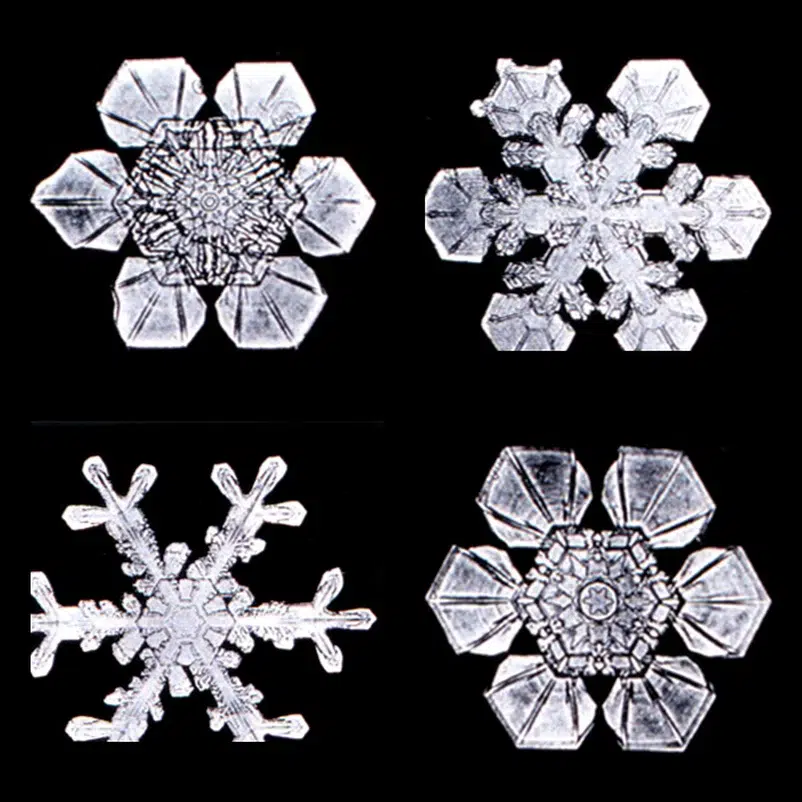
Real snow crystals, photographed by Wilson “Snowflake” Bentley and published in 1902 (public domain, NOAA). They’re not Emoto’s photos, but they show how beautiful ice crystals can be.
What the tests found
Emoto’s own photos weren’t a controlled experiment, so Dean Radin of the Institute of Noetic Sciences, a California group that studies consciousness, ran two more careful tests with him:
- 2006: about 2,000 people in Tokyo focused kind intentions on water kept in a shielded room in California. 100 judges, who didn’t know which water was which, rated the crystals from that water as more beautiful than crystals from control water kept elsewhere (Radin and others, 2006).
- 2008: about 1,900 people in Austria and Germany did the same over three days, and more than 2,500 judges rated the photos, all without knowing which was which. The “treated” crystals were rated more beautiful than control water kept beside them, though a second set of controls, kept further away, was rated slightly more beautiful than the treated water (Radin and others, 2008).
Neither test proves the idea, which is why we call it a lovely idea, not proven science. But they’re interesting results, and they keep people asking.
Try the rice experiment yourself
The rice experiment is the version anyone can try at home. Lots of people have filmed their own and shared them on YouTube and social media, with different results. The best way to make up your own mind is to do your own research, and try it:
- Cook some plain white rice and divide it evenly between three clean glass jars with lids.
- Label the jars. Write a kind phrase on the first, like “Thank you”. Write an unkind one on the second. Leave the third without a label.
- Keep them together. Put the jars side by side, out of direct sun, so they all get the same warmth and light.
- Speak to them every day for a month. Say kind words to the first jar and unkind words to the second. Ignore the third completely.
- Take a photo each day and compare the jars at the end.
Emoto said the “thank you” rice stayed best, and the ignored rice went off worst of all. To keep it a fair test, use the same rice and the same kind of jars, and keep everything clean. When you’re finished, throw the rice out. Don’t eat it.
The power of our words
Here’s where I stand. I believe the words we speak are powerful. What we say, and how we think, shapes the life we live. Positive speech and positive thinking have the power to create good things in our lives, and Emoto’s crystals are just one example people point to.
Words clearly affect people. A kind word can lift someone’s whole day, and a harsh one can stay with them for years. I also believe our words can affect the world around us, even the properties of things like water. That isn’t scientifically proven, and science may always find it hard to measure. It’s simply something I believe, and something our customers often talk to us about.
So speak words of life: to your family, to the people you work with, and to yourself. It costs nothing, and it’s never wasted.
Our view
We find Emoto’s work fascinating, and we love that it gets people thinking about water. Whatever you believe about words and water, it’s also worth knowing what’s in yours: bacteria and parasites like E. coli and Giardia, metals like lead, sediment from the roof or the bore, and anything else your source picks up.
So say thank you to your water. And if you’re not sure what’s in it, get it tested. We’ll tell you what’s worth treating, and what isn’t.
Interested in other water ideas? See our posts on the fourth phase of water and alkaline water.
Clean, safe water from your own tap: worth a thank you.
Not sure what’s in your water? Book a test.
Masaru Emoto and water: FAQs
What did Masaru Emoto claim about water?
He claimed that water exposed to kind words, pictures, music or prayer froze into beautiful, symmetrical ice crystals, while water exposed to harsh words or loud music formed broken or ugly crystals. He believed this showed water responds to our words and thoughts.
Has Masaru Emoto’s water experiment been proven?
Not scientifically. Emoto’s own photos weren’t a controlled test. Two later tests run with him, in 2006 and 2008, found that judges rated crystals from water given kind intentions as more beautiful, though the second test gave mixed results. It’s a lovely idea, not proven science.
How do I do the rice experiment at home?
Put cooked white rice into three clean jars with lids. Label one with a kind phrase like “thank you”, one with an unkind phrase, and leave one unlabelled. Keep them side by side, speak to the first two every day for a month, ignore the third, and photograph them each day. Throw the rice out afterwards.
Where can I see Emoto’s water crystal photos?
The Office Masaru Emoto website has a gallery of his crystal photographs, including water from rivers and lakes around the world, one from the Mount Cook glacier in New Zealand, and water that was played music. His books include many more.
Can words change water?
It hasn’t been proven scientifically. Emoto believed they can, and many people who talk to us about it believe it too. We believe words are powerful, so we find it a fascinating idea. Try the rice experiment and see what you think.
Who was Masaru Emoto?
A Japanese author, born in Yokohama in 1943, who wrote Messages from Water and The Hidden Messages in Water and appeared in the film What the Bleep Do We Know!?. He died in Tokyo in October 2014.
What actually changes the quality of drinking water?
What’s in it: bacteria and parasites like E. coli and Giardia, metals like lead, sediment, and chemicals from the roof, the ground or the pipes. A water test shows what’s in yours, and the right filter or UV system deals with what needs treating.
About the author
Steve Reynolds started Aqua Works in Warkworth in 2000. He has tested and treated drinking water for homes and businesses across Rodney and North Auckland for over 25 years. How it started.
Sources: Office Masaru Emoto, profile and crystal gallery; Wilson Bentley, snow crystal photographs (1902, public domain); Radin and others (2006), Explore; Radin and others (2008), Journal of Scientific Exploration. Checked 22 November 2026.
Don’t just take our word for it…

⭐⭐⭐⭐⭐
“Thank you to Aqua Filter Rodney, we had excellent service, fast, efficient, the serviceman was really great to deal with, and our tea and coffee now tastes like it should, wouldn’t be without the system, it’s marvelous.”
Merryl Houghton, 2021
⭐⭐⭐⭐⭐
“Excellent on-going service. Would highly recommend these guys to fix any water issues. Loving the taste of my water. …”
Tony Cohen, 2025
⭐⭐⭐⭐⭐
“These guys are really lovely, go above and beyond to help, great customer service, super professional and honest, gave really helpful advice, technician super respectful about punctuality, can’t recommend more highly, very happy with our new clean water. Thanks Steve and Richard!”
Frankie & the Flowers, 2026
Related reading
Tap a card to find out more.
The fourth phase of water
Another interesting water idea, and what the research says.

Alkaline water and ionisers
A look at the claims and the research.
The cheapest way to stay hydrated
And does coffee count?
Refill, not landfill
Why a water filter beats bottled water.

Water testing
Find out what’s really in your water.
Contaminants in water
What can be in tank, bore and town water, and how to fix it.
Curious about your own water? Get it tested.
From Mangawhai to Albany, we’ll test your water and tell you what’s worth treating, and what isn’t.