Quick answer
The cheapest way to stay hydrated is plain water from the tap, in a bottle you refill. In Auckland it costs about a quarter of a cent a litre, against over $3 a litre for bottled water and $9 a litre for energy drinks. Coffee and tea still count, in moderation. With a hot, dry El Niño summer on the way, drink little and often, and keep your electrolytes up on long, hot days.
- Tap water: about 0.25 cents a litre
- A shop drink a day: $900 to $2,000 a year
- Coffee and tea count, up to about 4 cups a day
- Energy drinks: caffeine plus up to 17 teaspoons of sugar
- Alcohol really does dry you out
- Pale straw pee means you’re drinking enough
Want tap water worth drinking? Call 0800 278 296
Staying hydrated shouldn’t cost you anything. Yet plenty of us spend thousands of dollars a year on bottled water, sports drinks, energy drinks and coffee, when the best drink of the lot comes out of the tap for next to nothing.
So we did the sums. We also looked into a few things everyone has an opinion on: does coffee dehydrate you, are energy drinks as bad as they sound, and do you really need electrolytes? Here’s what we found.
The cost: tap water vs everything else
In Auckland, Watercare charges $2.46 per 1,000 litres of water (including GST). That’s about a quarter of a cent a litre. Here’s how that stacks up against one drink a day from the dairy, the café or the service station.
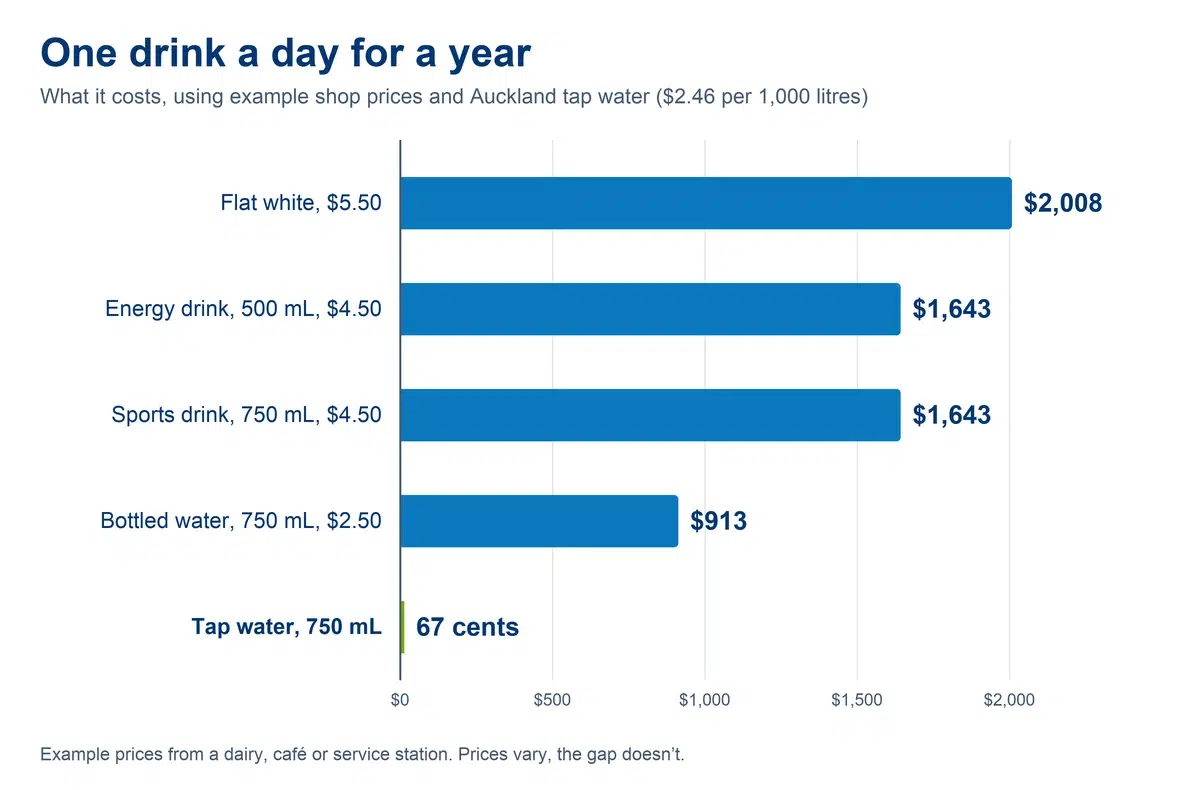
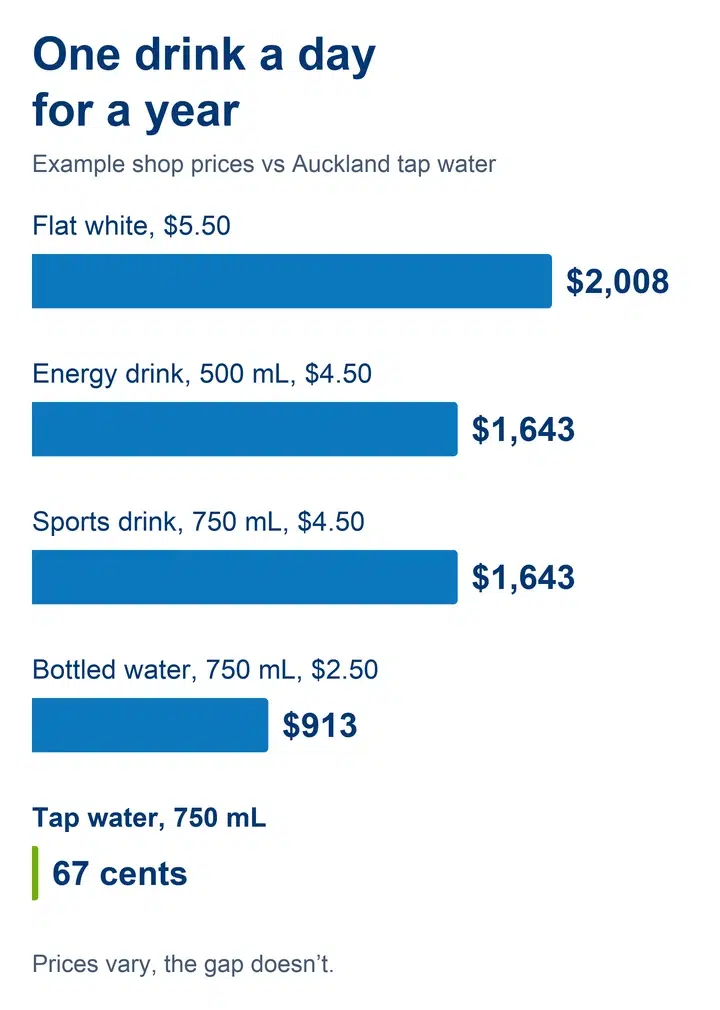
One drink a day adds up fast.
| Drink | Example price | Cost per litre | How many times dearer than tap water |
|---|---|---|---|
| Tap water (Auckland) | Refill your own bottle | About 0.25 cents | Cheapest |
| Bottled water | $2.50 for 750 mL | About $3.33 | About 1,350 times |
| Sports drink | $4.50 for 750 mL | $6.00 | About 2,400 times |
| Energy drink | $4.50 for 500 mL | $9.00 | About 3,650 times |
What that looks like over a year
- A tradie who buys two bottles of water and an energy drink every work day (about 230 days a year) spends about $2,185 a year. The same 2 litres a day from the tap costs about $1.13.
- Two kids with a $2.50 bottle of water in each lunchbox every school day (about 190 days) cost about $950 a year. Refilling their own bottles from the tap: about 70 cents.
- A flat white every work day comes to about $1,265 a year. We’re not telling you to give up your coffee. Just don’t pay for water as well.
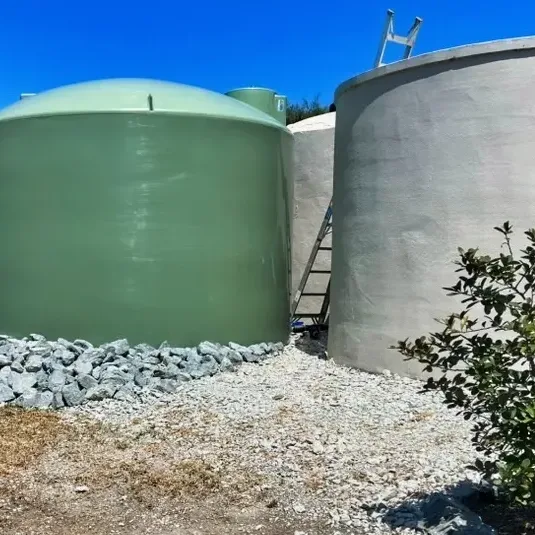
Even after filter changes, filtered tap water costs cents a litre, not dollars. And on tank water, the water itself is free once it’s in the tank: keep it safe to drink with filters and UV, and it’s the cheapest drink of all.
Does coffee dehydrate you?
We were hoping to have a real go at coffee here. The science won’t let us.
Caffeine is a mild diuretic: it can make you pee a bit more. But a cup of coffee or tea is mostly water, so you still end up ahead. Healthify NZ says that although caffeine can make you pee more often, caffeinated drinks don’t make you dehydrated, so tea and coffee count towards your fluids. Water is still best.
One study gave 50 regular coffee drinkers four mugs of coffee a day, and found they stayed just as hydrated as when they drank the same amount of water (Killer and others, 2014).
The catch: how much you have
Big doses are different. Around 250 to 300 mg of caffeine in one go, about three or four cups of instant coffee, can make you pee more for a few hours, especially if you don’t usually have caffeine (Maughan and Griffin, 2003). If you’re already dehydrated, Healthify suggests keeping tea and coffee under 4 cups a day.
Is tea a diuretic? The same rules apply. A cup of tea has less caffeine than a cup of coffee, so it counts towards your fluids too.

Having a coffee? Ask for a glass of water with it. It’s free.
Do energy drinks dehydrate you?
Energy drinks are where we can have a crack. The water in the can still counts, but you’re paying a lot for caffeine and sugar you don’t need.
- Caffeine: the Food Standards Code allows energy drinks up to 320 mg of caffeine per litre. That’s up to 160 mg in a 500 mL can. Two cans before lunch puts you past the 250 to 300 mg where caffeine starts to make you pee more.
- Sugar: when 1News tested 500 mL cans in 2024, every one had more sugar than the recommended 6 to 12 teaspoons for a whole day, and one had 17.3 teaspoons.
- Not as hydrating as water: Healthify NZ says to avoid high-sugar drinks like energy drinks, fizzy drinks and undiluted fruit juice when you need fluids.
- Not for kids: the label has to say they’re not suitable for young children, and the government’s HealthEd advice is that they’re not recommended for children and young people.
- Cost: at $4.50 a can, that’s $9 a litre, about 3,650 times the price of Auckland tap water.
One 500 mL energy drink
- Up to 160 mg of caffeine
- Up to 17.3 teaspoons of sugar
- About $9 a litre
- Not recommended for children
One 750 mL bottle of tap water: no caffeine, no sugar, about 0.2 cents.
Alcohol: the real diuretic
If you want a drink that actually dries you out, it’s alcohol. Healthify NZ says alcohol is a diuretic and makes dehydration worse.
After a hot day on the tools or at the beach, have a big glass of water first, before the cold one. And keep a glass of water next to you through the evening.
How much water should I drink a day?
As a guide, the European Food Safety Authority says women need about 2 litres of water a day and men about 2.5 litres, from food and drinks together, in mild weather and with normal activity. Around 70 to 80% of that comes from drinks, so think 6 to 8 glasses a day.
Hot weather and hard work change everything. Healthify NZ says a builder working in summer might need up to 5 litres a day.
- Drink little and often, rather than a lot all at once.
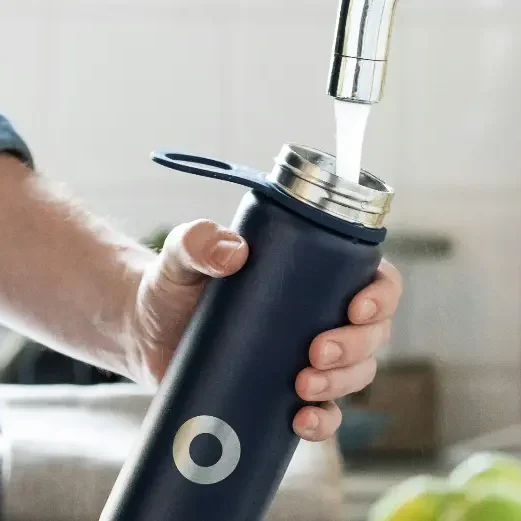
- Carry a bottle and refill it through the day.
- Keep a jug of water in the fridge. Cold water is easier to drink on a hot day.
- Have a glass with every meal, and one before you head out.
- Drink before you’re thirsty when it’s hot or you’re working hard.

6 to 8 glasses a day in mild weather. More when it’s hot.
Signs of dehydration
The first sign is feeling thirsty. Your pee also gets darker. According to Healthify NZ, the signs build up like this:
- Mild: thirst and darker pee.
- Moderate: a dry, sticky mouth, headache, feeling dizzy or light-headed, weakness, muscle cramps, feeling very tired, and peeing less with dark yellow pee.
- Severe: dry, flushed skin, not peeing for 8 hours or more, a fast heart rate, confusion, fainting.
Babies, older people and anyone working or exercising outside are most at risk. For mild dehydration, sip water often. If you notice moderate or severe signs, see a doctor or an after-hours clinic straight away, or call 111 in an emergency. For advice, call Healthline free on 0800 611 116.
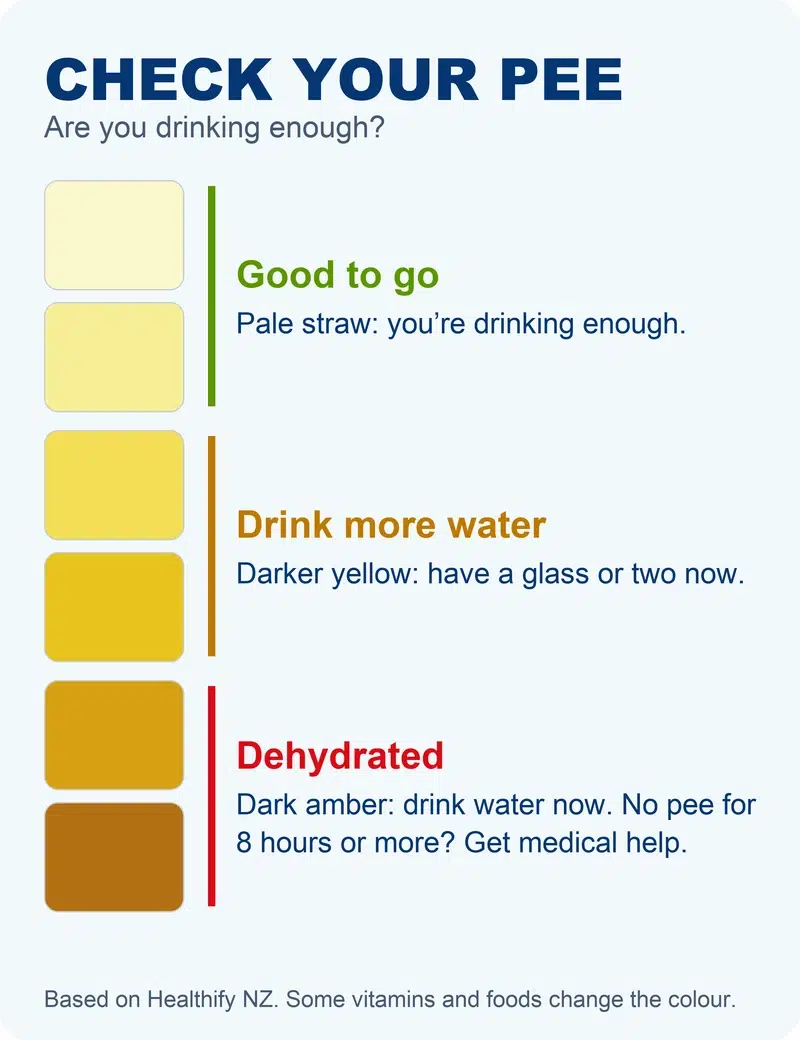
The quickest check there is.
Electrolytes: do you need them?
Electrolytes are the salts in your body, like sodium and potassium. They keep water in the right places. You lose some when you sweat, and you normally get them back from the food you eat.
So for most people on most days, water and normal meals are all you need. That’s also the cheapest way to keep your electrolytes up.
- Long, hot, hard days: Healthify NZ says that if you work or train outdoors in the heat at high intensity for many hours, you may need sports drinks or oral rehydration solutions as well as water.
- Tummy bugs: oral rehydration salts replace the water and salts you lose with vomiting or diarrhoea. Healthify says you can get them from pharmacies and supermarkets as drinks, ice blocks, sachets or fizzy tablets.
- Sports drinks aren’t a cure-all. When you’re sick, Healthify says to avoid fizzy drinks, undiluted juice, tea, coffee and sports drinks, because the sugar can make dehydration worse.
Our tip: keep a box of rehydration sachets in the first aid kit at home and in the ute. They take up no room, and they’re there on the scorcher you need them.
Safety tip
Homemade electrolyte drinks: Healthify warns that homemade rehydration drinks have to be made carefully, because too much salt can be dangerous. We’d skip the kitchen recipe and buy sachets made to the right strength.
Summer, drought and El Niño
This summer could be a hot one. In its outlook for November 2026 to January 2027, Earth Sciences New Zealand says temperatures in Northland and Auckland are most likely to be above average, rainfall below normal, and the north and east of the North Island are likely to see more frequent dry spells. Read more in our El Niño guide for tank owners.
Hot days mean more sweat, and more sweat means you need more water. Drink before you’re thirsty, work in the shade when you can, and keep an eye on older family members and neighbours, who don’t always feel thirsty.
On tank water? Watch the tank, too
A dry summer is hard on tank water. Keep an eye on your level with a tank level indicator, fix leaks early, and if you keep running low, think about a second water tank. Don’t let the tank run so low that the pump sucks up the sediment from the bottom.

Hot and dry: good for the beach, hard on the tank.
On the tools and in the lunchbox
The two places people spend the most on drinks are the work site and the school lunchbox. Both are easy wins.
- Tradies: fill a big insulated bottle or jug from the tap before you leave home. It stays cold for hours. WorkSafe tells employers to keep cool drinks available and make sure workers stay hydrated in the heat.
- Kids: a reusable bottle filled from the tap each morning, with a spare in the fridge for after school. Water is the best drink for kids, and it costs next to nothing.
- Everyone: keep a refill bottle in the car. Every refill is one less plastic bottle bought.
There’s more on lunchboxes, work sites and plastic in our article Refill, not landfill.

Refilled from the tap: about 70 cents a year for two kids.
Make your tap water taste good enough to drink
Plenty of people buy bottled water because they don’t like their tap water. On town water, that’s usually the chlorine taste. On tank water, it can be sediment, a musty taste, or worry about what’s in the tank. Fix that, and the cheapest drink is also the one you want.
- Under-bench water filter: filtered drinking water at the kitchen tap, the one you fill your bottles from.
- Whole house water filter: filtered water at every tap in the house. On town water it takes out the chlorine taste and smell (see chlorine in water).
- On tank water: filters and UV make rainwater safe to drink. See tank water treatment.
- Not sure what’s in your water? Start with a water test.
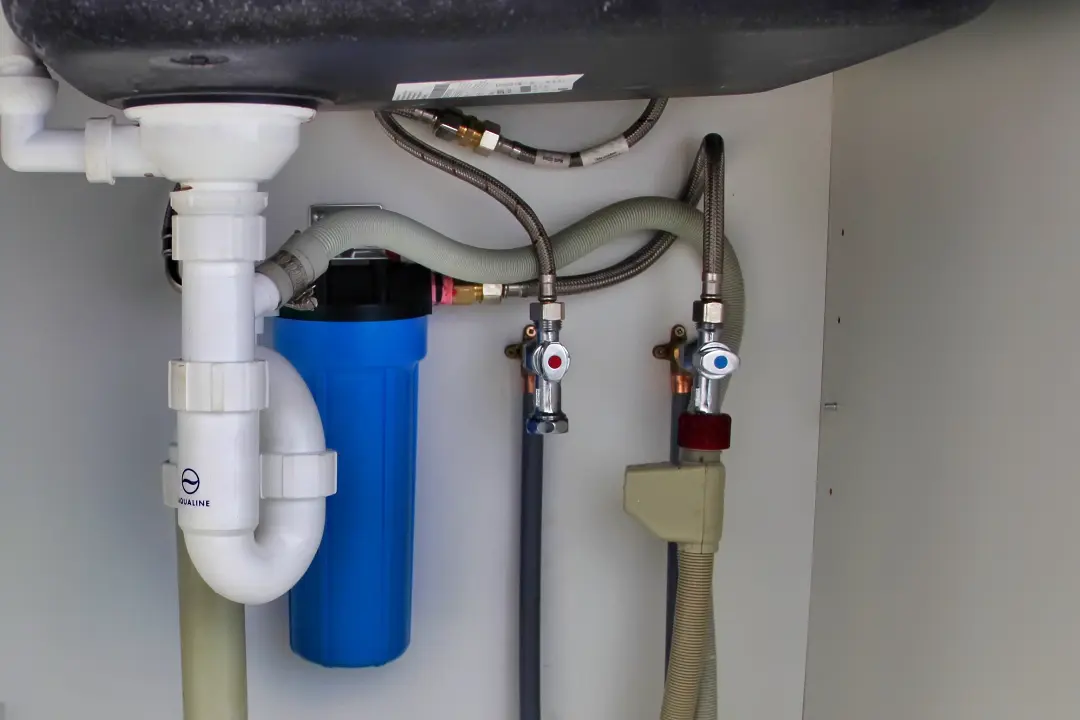
An under-bench filter, out of sight in the kitchen cupboard.
Want tap water worth drinking? Talk to us.
Staying hydrated: FAQs
What is the cheapest way to stay hydrated?
Drink tap water from a bottle you refill. In Auckland, Watercare charges $2.46 per 1,000 litres, about a quarter of a cent a litre. A 750 mL bottle of water at $2.50 works out at about $3.33 a litre, and an energy drink at $4.50 for 500 mL is $9 a litre.
Does coffee dehydrate you?
Not in normal amounts. Caffeine can make you pee a bit more, but Healthify NZ says caffeinated drinks don’t make you dehydrated, so coffee counts towards your fluids. Large doses, around 250 to 300 mg of caffeine at once, can make you pee more for a few hours. Water is still best.
Is tea a diuretic?
Tea contains caffeine, which is a mild diuretic, but a cup of tea is mostly water and counts towards your fluids. If you’re already dehydrated, Healthify NZ suggests keeping tea and coffee under 4 cups a day.
Do energy drinks dehydrate you?
The water in an energy drink still counts, but a 500 mL can can contain up to 160 mg of caffeine and, in a 2024 1News test, up to 17.3 teaspoons of sugar. Healthify NZ says to avoid high-sugar drinks like energy drinks when you need fluids. They’re not recommended for children.
Does alcohol dehydrate you?
Yes. Healthify NZ says alcohol is a diuretic and makes dehydration worse. Have a glass of water before and between drinks, especially after a hot day.
How much water should I drink a day?
As a guide, about 2 litres a day for women and 2.5 litres for men, from food and drinks together, in mild weather. That’s roughly 6 to 8 glasses of drinks a day. In hot weather or hard physical work you need much more: Healthify NZ says a builder working in summer might need up to 5 litres a day.
What are the signs of dehydration?
Thirst and darker pee are the first signs. Moderate dehydration brings a dry, sticky mouth, headache, dizziness, weakness, cramps and dark yellow pee. Not peeing for 8 hours or more, confusion or fainting are signs of severe dehydration: get medical help, or call 111 in an emergency.
Do I need electrolyte drinks?
Most people get enough electrolytes from food and only need water. If you work or train hard outdoors in the heat for many hours, Healthify NZ says you may need sports drinks or oral rehydration solutions as well. For a tummy bug, use oral rehydration salts from a pharmacy or supermarket.
Is a homemade electrolyte drink safe?
Healthify NZ warns that homemade rehydration drinks have to be made carefully, because too much salt can be dangerous. Oral rehydration sachets from a pharmacy or supermarket are made to the right strength.
Is tap water safe to drink in NZ?
Town water is treated and tested by your council or water supplier. Tank water and bore water are your own responsibility: rainwater needs filters and UV to be safe to drink, and bore water should be tested.
About Aqua Works
Steve Reynolds started Aqua Works in Warkworth in 2000. We’ve installed and serviced water filters, UV systems and water treatment across Rodney and North Auckland for over 25 years. How it started.
This article is general information, not medical advice. If you’re worried about dehydration, talk to your doctor or call Healthline on 0800 611 116.
Sources: Healthify NZ, Dehydration in adults and Oral rehydration salts; Killer, Blannin and Jeukendrup, No evidence of dehydration with moderate daily coffee intake, PLoS ONE (2014); Maughan and Griffin, Caffeine ingestion and fluid balance: a review, Journal of Human Nutrition and Dietetics (2003); European Food Safety Authority, Scientific Opinion on Dietary Reference Values for water (2010); Food Standards Australia New Zealand, Caffeine; HealthEd, Behind the hype: energy drinks; 1News, What are energy drinks really doing to your body? (2024); Earth Sciences New Zealand, Seasonal Climate Outlook November 2026 to January 2027; Watercare, Residential charges 2026/27; WorkSafe, Temperature extremes. Read 13 November 2026.
Don’t just take our word for it…

⭐⭐⭐⭐⭐
“…we had excellent service, fast, efficient, the serviceman was really great to deal with, and our tea and coffee now tastes like it should, wouldn’t be without the system, it’s marvelous.”
Merryl Houghton, 2021
⭐⭐⭐⭐⭐
“There was an under sink filter installed when we moved in to our current home and we have been so impressed with the results and the friendly, reliable service from Rich and the other members of the Aquaworks team that we also had one installed at a family member’s home. Highly recommend”
Ben T, 2025
⭐⭐⭐⭐⭐
“Updated filter system installed by Aqua Works one year ago..our bore water is a treat to drink now and general washing much brighter…great service..a top team!”
Alec Brewis, 2022
Related reading
Tap a card to find out more.
Refill, not landfill
Why a water filter and a reusable bottle beat bottled water.
El Niño and your water tank
Get your tank ready for a hot, dry summer.
Under-bench water filter
Filtered drinking water at the kitchen tap.
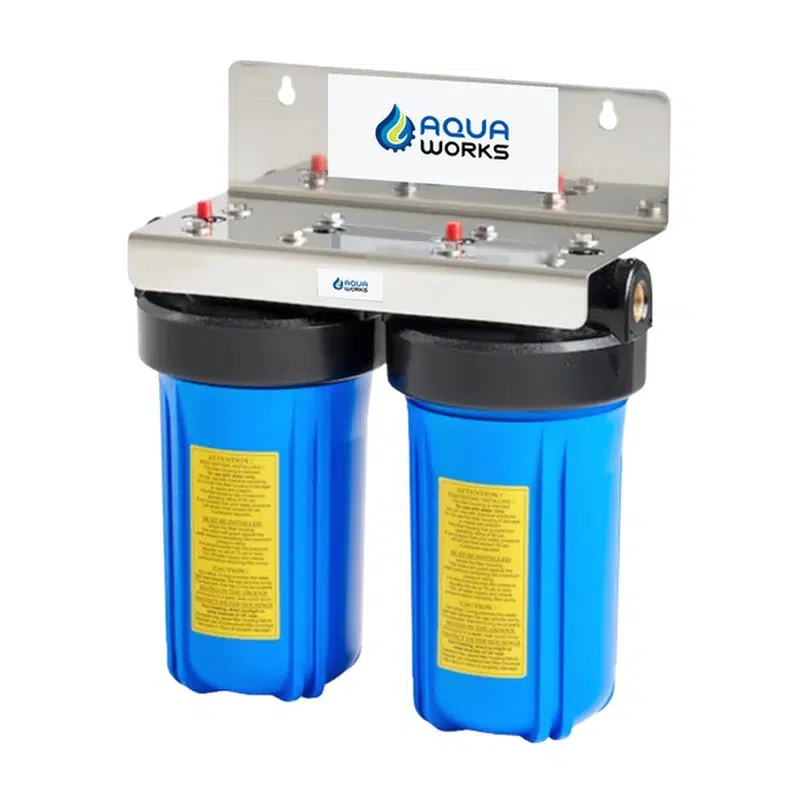
Whole house water filter
Filtered water at every tap in the house.
Tank water treatment
Filters and UV that keep rainwater safe to drink.
Chlorine in town water
Why town water tastes of chlorine, and how to remove it.
Make your tap water the drink you reach for
From Mangawhai to Albany, we’ll find the right filter for your water, install it, and keep it serviced, so the cheapest drink in the house is also the best.