We get asked about alkaline water and water ionisers a lot. Some people swear by them, and others think they’re a waste of money. It’s an interesting topic, so we’ve pulled together what the different groups say, the pros and cons, and links to the research so you can read further.
We have a fairly neutral view on alkaline water. We don’t sell alkaline water machines, and we’re not here to tell you what to drink. Do your own research, and talk to your doctor if you have a health condition.
What is alkaline water?
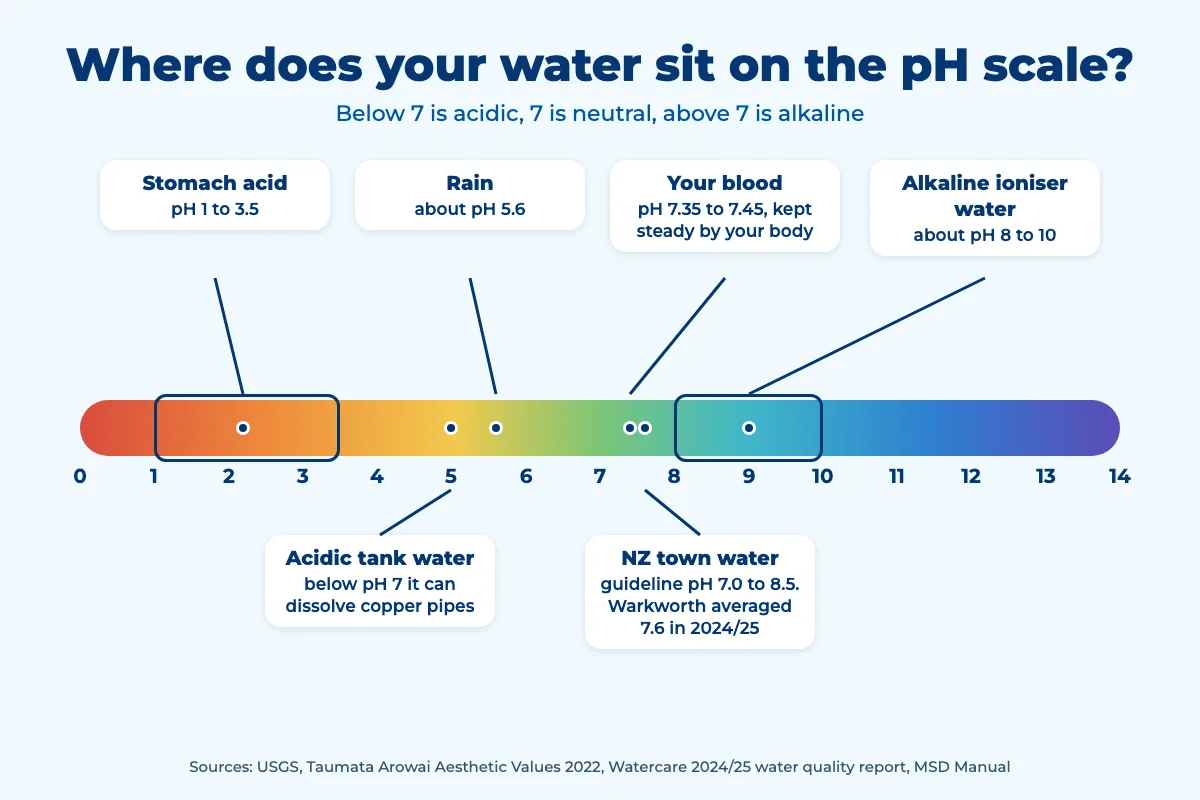
pH measures how acidic or alkaline water is, on a scale of 0 to 14. Below 7 is acidic, 7 is neutral, and above 7 is alkaline. Alkaline water is simply water with a pH above 7.
Alkaline bottled water usually gets its higher pH from minerals. A water ioniser (sometimes spelled ionizer) is an electric machine that sits on the bench or under the sink. It passes electricity through tap water and splits it into two streams: alkaline water to drink, usually around pH 8 to 10, and acidic water that goes down the drain or is used for cleaning.
Not to be confused with our whole house ioniser. Our whole house ioniser is a different product: a filter system with a magnetic unit for town water. It has no power and no electrolysis, it doesn’t make alkaline water, and we make no health claims for it.
What supporters say
People who drink alkaline water often say it:
- tastes smoother than their tap water
- helps them stay hydrated, especially after exercise
- eases acid reflux
- balances the body’s pH, or “neutralises acid”
- works as an antioxidant (sellers point to a negative “ORP” reading)
- helps prevent disease, including cancer
Some of these ideas come from real studies. A 2012 lab study found that water at pH 8.8 switched off pepsin, an enzyme involved in reflux, in a test tube (Koufman and Johnston, 2012). Small studies have reported changes in hydration markers and blood thickness after drinking alkaline water (Heil, 2010; Weidman and others, 2016). And many people simply prefer the taste, which is a perfectly good reason to drink more water.
What the research and health bodies say
- Your body controls its own pH. Your blood stays between about pH 7.35 and 7.45, kept steady by your lungs, kidneys and natural buffers (MSD Manual). Your stomach is strongly acidic, at around pH 1 to 3.5, so alkaline water is neutralised soon after you drink it. It can make your urine slightly more alkaline, which is your kidneys doing their job.
- Cancer. A 2016 systematic review found almost no research on alkaline water and cancer, and concluded that promoting it to prevent or treat cancer isn’t justified (Fenton and Huang, BMJ Open). Cancer Research UK and Cancer Council Australia say what you eat and drink doesn’t change your body’s pH.
- Reflux. The well-known reflux study tested alkaline water on an enzyme in a lab, not on people. The one clinical study combined alkaline water with a plant-based Mediterranean diet, so we can’t tell what the water did on its own (Zalvan and others, 2017).
- Hydration and exercise. The studies are small and short, several were funded by water companies, and many used bottled mineral water rather than water from an ioniser. A 2024 systematic review found alkaline water did no better than ordinary mineral water (Sunardi and others, 2024).
- “Micro-clustered” water and ORP. Claims that alkaline water has smaller “clusters” of water molecules have no scientific support. A negative ORP reading shows there’s dissolved hydrogen gas in the water. It doesn’t prove a health benefit (McGill Office for Science and Society).
- Mayo Clinic says that for most people, alkaline water isn’t better than plain water (Mayo Clinic).
The pros and cons
Pros
- Some people prefer the taste, and anything that helps you drink more water is good.
- For healthy people, there’s no evidence that alkaline water at a sensible pH is harmful.
- A few small studies point to effects that may be worth more research.
Cons
- There’s no good evidence that it’s better for your health than ordinary tap water.
- Ionisers cost money to buy and look after, and part of the water goes down the drain as the acidic stream.
- It may not suit everyone. If you have kidney disease, or take calcium-based or other regular medicines, talk to your doctor first, and avoid very high pH water above 9.8 (Mayo Clinic; a 2022 case report).
- Regulators in the US and the UK have acted against sellers making health claims for ionised and alkaline water (US Federal Trade Commission, 2021; UK Advertising Standards Authority).
What about New Zealand tap water?
Most town water in New Zealand is already slightly alkaline. Taumata Arowai’s guideline for drinking water is pH 7.0 to 8.5, ideally 7.4 to 8.0 (Aesthetic Values for Drinking Water 2022). That’s about taste and looking after pipes, not a health limit, and the World Health Organization doesn’t set a health limit for pH either. In 2024/25, Warkworth’s town water averaged pH 7.6 (Watercare water quality report).
The one time we do raise the pH: acidic tank water
Rain is naturally a little acidic, at about pH 5.6 (USGS). New Zealand guidance lists roof water as corrosive (Household water supplies guide; BRANZ), and acidic water can slowly dissolve copper from pipes, and lead from some fittings.
We’ve seen it first hand: acidic tank water can eat through copper pipe and cause pinhole leaks. Not every pinhole leak is down to the water, though. We’ve also come across a batch of copper pipe that was thinner than the normal standard.
When tank water is acidic, we fit a neutralising filter to bring the pH back to around neutral. That’s about protecting your plumbing, not a health treatment, and we aim for neutral, not pH 9 or 10.
Seeing blue-green stains in your basin, bath or shower? Give us a call on 0800 278 296. It’s a sign that copper is dissolving in your plumbing from acidic water.
Our view
Alkaline water is an interesting topic, but in our humble opinion there are bigger things to think about in your water. We think it’s far more important to remove contaminants that are known to cause long-term health problems:
- Lead and other heavy metals, which can come from old pipes, fittings and some roofs. See lead in water.
- Bacteria and parasites like E. coli and Giardia in tank and bore water. UV treatment deals with these.
- Chlorine. Councils add chlorine to town water for a good reason: it keeps the water safe on its way to your tap. But plenty of people don’t like the taste or smell, and a carbon filter takes it out. See chlorine in water.
If you’re not sure what’s in your water, start with a water test. Then you can decide what’s worth treating.
Further reading
These are the sources we used, if you’d like to read more:
- Mayo Clinic: Is alkaline water better for you than plain water?
- Fenton and Huang (2016), BMJ Open: systematic review of dietary acid load, alkaline water and cancer
- Cancer Research UK: alternative cancer diets
- Cancer Council Australia: do higher alkaline diets protect against cancer?
- Sunardi and others (2024): systematic review of alkaline water and hydration
- Koufman and Johnston (2012): pH 8.8 water and pepsin, a lab study
- Zalvan and others (2017), JAMA Otolaryngology: alkaline water and a Mediterranean diet for reflux
- McGill Office for Science and Society: alkaline water
- MSD Manual: how your body balances acid and alkali
- Taumata Arowai: Aesthetic Values for Drinking Water 2022 (PDF)
- World Health Organization: pH in drinking water (PDF)
- Watercare: 2024/25 water quality report (PDF)
- Household water supplies: the selection, operation and maintenance of individual household water supplies (PDF)
- BRANZ: collecting drinking water from roofs
Not sure what’s in your water?
Book a water test and we’ll tell you what’s worth treating. Call 0800 278 296.
Alkaline water: FAQs
Is alkaline water better for you than tap water?
There’s no good evidence that it is. Mayo Clinic says that for most people, alkaline water isn’t better than plain water. Some people prefer the taste, and drinking more water of any kind is good for you.
Does alkaline water prevent cancer?
There’s no evidence that it does. A 2016 systematic review found almost no research on alkaline water and cancer, and said promoting it to prevent or treat cancer isn’t justified. Cancer Research UK and Cancer Council Australia say food and drink don’t change your body’s pH.
Is alkaline water safe to drink?
For healthy people, there’s no evidence that alkaline water at a sensible pH is harmful. If you have kidney disease, or take calcium-based or other regular medicines, talk to your doctor first, and avoid very high pH water above 9.8.
What is a water ioniser?
An electric machine that passes electricity through tap water and splits it into two streams: alkaline water to drink, usually around pH 8 to 10, and acidic water that goes down the drain or is used for cleaning.
Is your whole house ioniser an alkaline water ioniser?
No. Our whole house ioniser is a filter system with a magnetic unit for town water. It has no power and no electrolysis, it doesn’t make alkaline water, and we make no health claims for it.
Why is my tank water acidic?
Rain is naturally a little acidic, at about pH 5.6, so roof water can be corrosive. Acidic water can dissolve copper from your pipes, which can cause blue-green stains and, over time, pinhole leaks. A neutralising filter brings the pH back to around neutral.
What do blue-green stains in my shower mean?
They’re a sign that copper is dissolving from your pipes, usually because the water is acidic. Give us a call on 0800 278 296 and we’ll test the water and check your plumbing.