Drinking Water Safety Plans
Who needs one, what goes in it, and how we can write yours.
What is a Drinking Water Safety Plan?
A Drinking Water Safety Plan (DWSP) is a written plan for your water supply. It records what could go wrong, from source to tap, and how you stop it making people sick.
Under the Water Services Act 2021, most drinking water suppliers serving more than 25 people need one. For the bigger picture, see our guide to NZ drinking water regulations.
Rather not write it yourself? Call Steve on 0800 278 296.
Do you need a Drinking Water Safety Plan?
It depends on how many people your supply serves. Source: Water Services Authority (Taumata Arowai)
Yes: more than 25 people
Who: registered supplies serving more than 25 people, such as schools, marae, campgrounds, accommodation, community schemes and water carriers.
You need a plan, and you confirm or update it each time you re-register, every five years.
No plan: business or community supply of 25 or fewer
Who: businesses, marae and community halls that supply 25 or fewer people.
You don’t need a plan, but you still need to register by November 2028 and keep your water safe.
Not a supplier: household-only supply of 25 or fewer
Who: a home with its own supply, or a supply shared only between homes, serving 25 or fewer people.
You’re not a drinking water supplier, so you don’t need a plan or registration.
What goes into a Drinking Water Safety Plan?
The regulator publishes templates for different supply sizes. Most plans cover these eight things.
1
Your supply
Where your water comes from, how it’s stored and treated, and who you supply.
2
What could go wrong
The hazards and risks from source to tap, like animals near a bore, a dirty tank or a failed UV lamp.
3
How you control the risks
The barriers that keep your water safe, such as filtration, UV disinfection and source protection.
4
Monitoring and testing
What you check, how often, and the water tests you do to prove the barriers are working.
5
When things go wrong
What you do in an incident or emergency, including boil water notices and who you contact.
6
Improvements
The upgrades you plan to make, and when, to lower the risks over time.
7
Records and reporting
The records you keep and what you report to the regulator each year.
8
Review
Confirm or update the plan at each five-yearly re-registration, and whenever your supply changes.
Writing a plan is a big job. Let us do it.
Call Steve. We’ll assess your supply, write your plan and take care of the rest.
Don’t just take our word for it
⭐⭐⭐⭐⭐
“Good on you, thanks for our Water Safety Plan. Taumata Arowai have approved us and we are now registered. Good work mate, we flew through. Cheers and thanks heaps.”
Kevin Smith, Kevs Contracting Ltd
Water carrier in the Whangarei District, November 2022
Hand it over to us
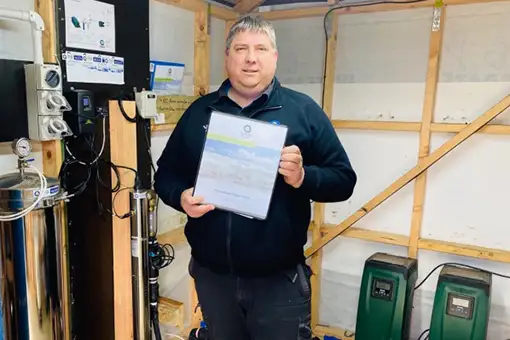
A good plan needs someone who understands your water supply, the treatment and the rules. Four of our team have passed the NZQA course on writing Drinking Water Safety Plans, and four have passed the NZQA small drinking water supplies course.
We visit your site, test your water, check your treatment and write a plan that fits how your supply actually works, so it’s a living document your team can use, not paperwork that sits in a drawer.
Find out more about our Water Safety Plan service.
One call, everything sorted
We’ve looked after water systems for Rodney businesses, schools and rural supplies since 2000. We can take care of:
On-site assessment of your supply
Water testing through an accredited lab
Treatment upgrades so your supply meets the rules
Writing your Drinking Water Safety Plan
Registering your supply on your behalf
Acting as your water operator
Ongoing servicing, testing and records
A plan that works on site
Safe drinking water depends on the whole system working together: the source, collection, storage, treatment, monitoring and maintenance. A good plan covers all of it, in plain language your team can follow.
Local expertise. Local trust.
We’re a local Warkworth team with experience in water filtration, commercial UV treatment, water pumps, rainwater harvesting and bore water treatment. We’ve written plans for water carriers and small suppliers since the Water Services Act began.
Drinking Water Safety Plan FAQs
What is a Drinking Water Safety Plan?
A written plan for your water supply that records what could go wrong, from source to tap, and how you manage those risks so the water is safe to drink. It also sets out what you do if something goes wrong.
Who needs a Drinking Water Safety Plan?
Registered drinking water suppliers serving more than 25 people, such as schools, marae, campgrounds, accommodation, community schemes and water carriers. Since August 2025, supplies serving 25 or fewer people no longer need one.
My supply serves 25 or fewer people. Do I need a plan?
No. If it’s a business or community supply, you still need to register by November 2028 and keep your water safe, but you don’t need a plan. If it only supplies homes, it isn’t a drinking water supplier at all.
What goes into a Drinking Water Safety Plan?
A description of your supply, the hazards and risks, how you control them, your monitoring and testing, what you do in an incident, planned improvements, your records and when you review the plan.
How often do I need to update my plan?
You confirm or update it each time you re-register your supply, every five years. It’s good practice to review it whenever your supply changes or after an incident.
Is there a template I can use?
Yes. The Water Services Authority (Taumata Arowai) publishes templates for different supply sizes. Filling one in well still takes a good understanding of your supply and treatment, which is where we can help.
Can I use an Acceptable Solution instead?
If your supply qualifies, an Acceptable Solution can be a simpler way to comply. We’ll tell you which pathway suits your supply, the Quality Assurance Rules or an Acceptable Solution.
Why do Drinking Water Safety Plans matter?
In 2016, thousands of people in Havelock North became ill with Campylobacter after the town’s water supply was contaminated. The inquiry that followed led to New Zealand’s new drinking water rules. A good plan helps make sure it doesn’t happen to your supply.
Can Aqua Works write my plan?
Yes. Four of our team have passed the NZQA course on writing Drinking Water Safety Plans. We assess your supply, test your water, check your treatment and write your plan. We can also register your supply for you and act as your water operator. See our Water Safety Plan service or call Steve on 0800 278 296.
What happens if I don’t have a plan?
If your supply needs one, the regulator can take enforcement action, including warnings, compliance orders, fines or prosecution.
Get your Drinking Water Safety Plan sorted
Book a free onsite visit. We’ll write your plan and take care of everything from registration to ongoing servicing.